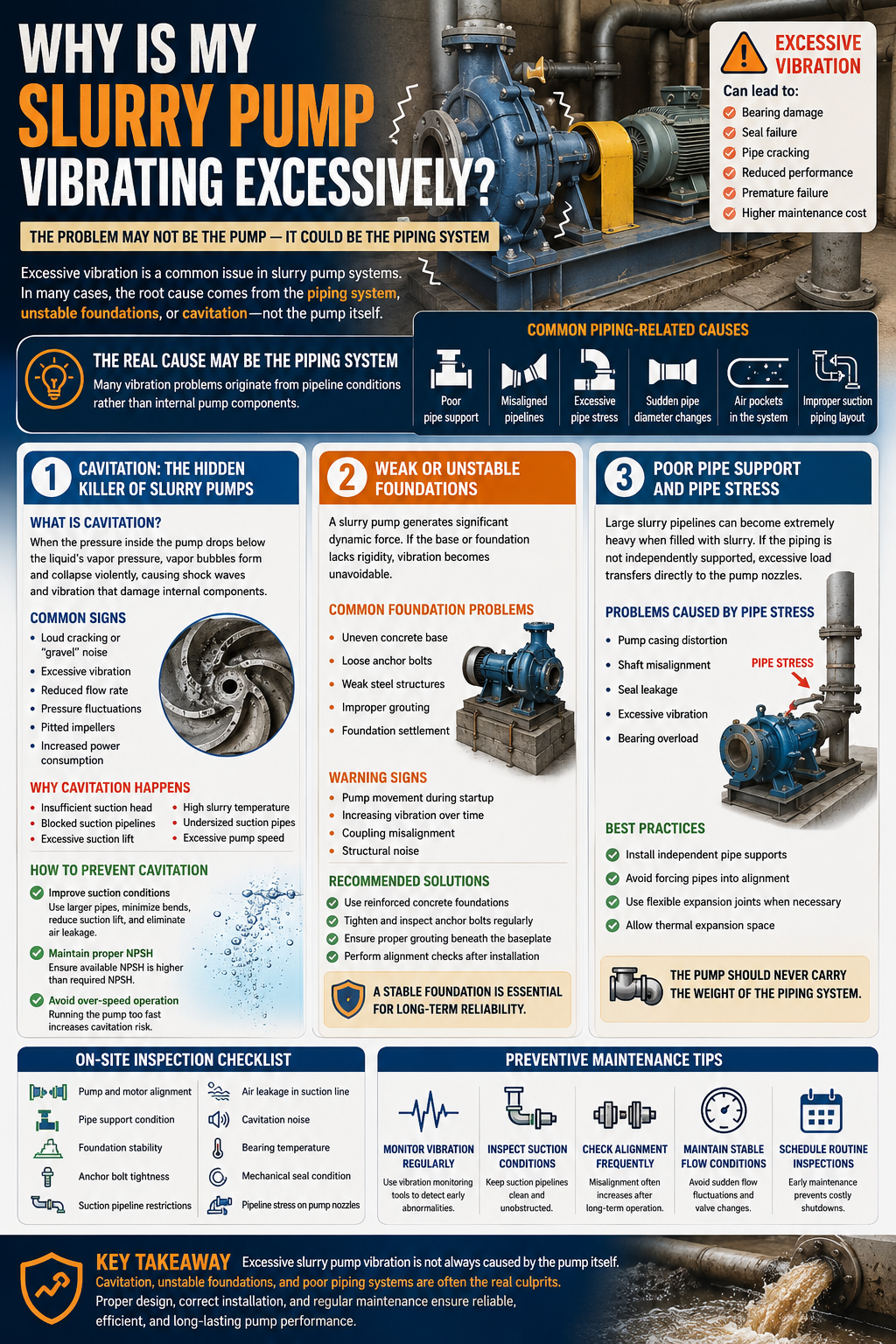
Excessive vibration is one of the most common issues in slurry pump systems. Many operators immediately assume the pump itself is defective, but in reality, the root cause is often related to the piping system rather than the pump.
Improper pipeline design, unstable foundations, cavitation, or poor installation practices can create severe vibration problems that reduce efficiency, increase maintenance costs, and shorten equipment lifespan.
In this article, we’ll explain the most common causes of slurry pump vibration, introduce the concept of cavitation, and discuss why proper piping support and foundation stability are critical for reliable operation.
Why Slurry Pump Vibration Is Dangerous
Excessive vibration can lead to:
- Bearing damage
- Mechanical seal failure
- Shaft misalignment
- Pipe cracking
- Reduced flow performance
- Increased energy consumption
- Premature equipment failure
If vibration is ignored for too long, the entire pumping system may suffer serious structural damage.
The Real Cause May Be the Piping System
Many vibration problems originate from pipeline conditions rather than internal pump components.
Common piping-related causes include:
- Poor pipe support
- Misaligned pipelines
- Excessive pipe stress
- Sudden pipe diameter changes
- Air pockets inside the system
- Improper suction piping layout
When pipelines apply external force to the pump casing, vibration levels can increase dramatically.
1. Cavitation: The Hidden Killer of Slurry Pumps
One of the most misunderstood causes of pump vibration is cavitation.
What Is Cavitation?
Cavitation occurs when the pressure inside the pump drops below the liquid’s vapor pressure, causing vapor bubbles to form. These bubbles collapse violently inside the pump, generating shock waves and vibration.
This phenomenon can seriously damage internal components.
Common Signs of Cavitation
- Loud cracking or “gravel” noise
- Excessive vibration
- Reduced flow rate
- Pressure fluctuations
- Pitted impellers
- Increased power consumption
Why Cavitation Happens
Typical causes include:
- Insufficient suction head
- Blocked suction pipelines
- Excessive suction lift
- High slurry temperature
- Undersized suction pipes
- Excessive pump speed
How to Prevent Cavitation
Improve Suction Conditions
- Use larger suction pipes
- Minimize pipe bends and elbows
- Reduce suction lift distance
- Eliminate air leakage
Maintain Proper NPSH
Ensure the available Net Positive Suction Head (NPSH) exceeds the pump’s required NPSH.
Avoid Over-Speed Operation
Running the pump too fast increases the risk of cavitation.
2. Weak or Unstable Foundations
A slurry pump generates significant dynamic force during operation. If the base or foundation lacks rigidity, vibration becomes unavoidable.
Common Foundation Problems
- Uneven concrete base
- Loose anchor bolts
- Weak steel structures
- Improper grouting
- Foundation settlement
Warning Signs
- Pump movement during startup
- Increasing vibration over time
- Coupling misalignment
- Structural noise
Recommended Solutions
- Use reinforced concrete foundations
- Tighten and inspect anchor bolts regularly
- Ensure proper grouting beneath the baseplate
- Perform alignment checks after installation
A stable foundation is essential for long-term pump reliability.
3. Poor Pipe Support and Pipe Stress
Large slurry pipelines can become extremely heavy when filled with slurry.
If the piping is not independently supported, excessive load transfers directly to the pump nozzles.
Problems Caused by Pipe Stress
- Pump casing distortion
- Shaft misalignment
- Seal leakage
- Excessive vibration
- Bearing overload
Best Practices
- Install independent pipe supports
- Avoid forcing pipes into alignment
- Use flexible expansion joints when necessary
- Allow thermal expansion space
The pump should never carry the weight of the piping system.
On-Site Inspection Checklist
When troubleshooting slurry pump vibration, inspect the following:
✅ Pump and motor alignment
✅ Pipe support condition
✅ Foundation stability
✅ Anchor bolt tightness
✅ Suction pipeline restrictions
✅ Air leakage in suction line
✅ Cavitation noise
✅ Bearing temperature
✅ Mechanical seal condition
✅ Pipeline stress on pump nozzles
Preventive Maintenance Tips
Monitor Vibration Regularly
Use vibration monitoring tools to detect early abnormalities.
Inspect Suction Conditions
Keep suction pipelines clean and unobstructed.
Check Alignment Frequently
Misalignment often increases after long-term operation.
Maintain Stable Flow Conditions
Avoid sudden flow fluctuations and valve changes.
Schedule Routine Inspections
Early maintenance prevents costly shutdowns.
Conclusion
Excessive slurry pump vibration is not always caused by the pump itself. In many cases, the real problem lies in the piping system, unstable foundations, or cavitation conditions.
Understanding these issues and performing proper system inspections can significantly improve reliability, reduce downtime, and extend equipment lifespan.
A stable piping system is just as important as the pump itself.