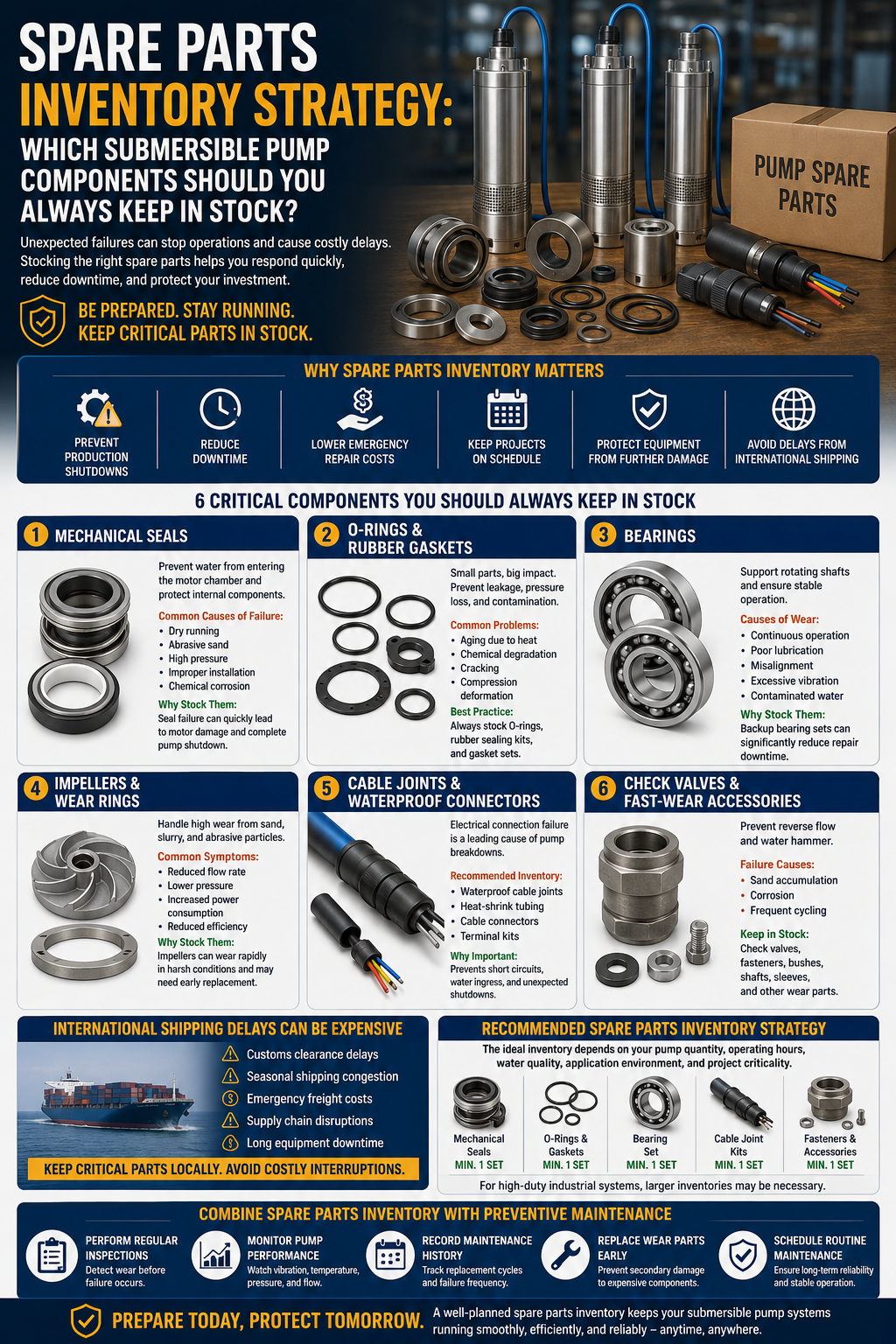
Unexpected pump failures can bring agricultural irrigation, industrial production, and water supply systems to a complete stop. In many cases, the biggest problem is not the repair itself — it is the long waiting time for replacement parts, especially in remote regions or during international shipping delays.
For this reason, maintaining a proper spare parts inventory is one of the smartest strategies for submersible pump users.
In this article, we’ll explain which submersible pump components are most vulnerable to wear, why they should be stocked in advance, and how proper spare parts planning can reduce downtime and maintenance costs.
Why Spare Parts Inventory Matters
When a critical pump component fails unexpectedly, operations may stop for days or even weeks if replacement parts are unavailable.
Common risks include:
- Production shutdowns
- Irrigation interruptions
- Emergency repair costs
- Delayed project schedules
- Increased equipment damage
- Expensive international shipping fees
A well-planned spare parts inventory helps operators respond quickly and maintain stable system performance.
The Most Commonly Worn Submersible Pump Components
Not all pump parts fail at the same rate. Some components experience continuous wear due to friction, pressure, heat, sand, or chemical exposure.
The following parts are highly recommended for backup inventory.
1. Mechanical Seals
Mechanical seals are among the most vulnerable parts in a submersible pump.
They prevent water from entering the motor chamber and protect internal components from contamination.
Why They Fail
Common causes include:
- Dry running
- Abrasive sand particles
- High pressure
- Improper installation
- Chemical corrosion
Warning Signs
- Water leakage
- Motor moisture alarms
- Reduced pump efficiency
- Increased vibration
Why You Should Stock Them
Seal failure can quickly lead to motor damage and complete pump shutdown.
Because seals are wear items, keeping replacement sets in inventory is strongly recommended.
2. O-Rings and Rubber Gaskets
O-rings and sealing gaskets are inexpensive but critical components.
Even a small damaged seal can cause leakage, pressure loss, or contamination.
Common Problems
- Aging due to heat
- Chemical degradation
- Cracking
- Compression deformation
Best Practice
Always stock:
- O-rings
- Rubber sealing kits
- Gasket sets
These parts are low-cost but essential for emergency maintenance.
3. Bearings
Pump bearings support rotating shafts and ensure stable operation.
Over time, bearings wear due to:
- Continuous operation
- Poor lubrication
- Misalignment
- Excessive vibration
- Contaminated water
Signs of Bearing Failure
- Abnormal noise
- Increased vibration
- Overheating
- Shaft instability
Inventory Recommendation
For critical systems, maintaining backup bearing sets can significantly reduce repair downtime.
4. Impellers and Wear Rings
In applications involving sand, slurry, or abrasive particles, impellers and wear rings can wear rapidly.
Common Symptoms
- Reduced flow rate
- Lower pressure
- Increased power consumption
- Reduced efficiency
Why Inventory Is Important
Impellers may require replacement long before the motor fails, especially in harsh operating conditions.
5. Cable Joints and Waterproof Connectors
Electrical connection failures are common in submersible pump systems.
Poor sealing or cable damage can cause:
- Short circuits
- Water ingress
- Motor burnout
- Unexpected shutdowns
Recommended Spare Parts
Keep backup:
- Waterproof cable joints
- Heat-shrink tubing
- Cable connectors
- Terminal kits
These components are especially important for remote installations.
6. Check Valves and Fast-Wear Accessories
Check valves help prevent reverse flow and water hammer.
Over time, valve components may fail due to:
- Sand accumulation
- Corrosion
- Frequent cycling
Stocking spare valves and fast-wear accessories helps prevent sudden system interruptions.
International Shipping Delays Can Be Expensive
Many customers underestimate the impact of international logistics delays.
If spare parts must be shipped internationally after a breakdown occurs, operations may remain offline for extended periods.
Potential risks include:
- Customs clearance delays
- Seasonal shipping congestion
- Emergency freight costs
- Supply chain disruptions
Keeping critical components in local inventory helps avoid these costly interruptions.
Recommended Spare Parts Inventory Strategy
The ideal inventory depends on:
- Pump quantity
- Operating hours
- Water quality
- Application environment
- Project criticality
Basic Recommendation
For each critical pump system, keep at least:
- 1 set of mechanical seals
- 1 set of O-rings and gaskets
- 1 bearing set
- Backup cable joint kits
- Common fasteners and accessories
For high-duty industrial systems, larger inventories may be necessary.
Preventive Maintenance + Spare Inventory = Maximum Reliability
A spare parts strategy works best when combined with preventive maintenance.
Recommended Practices
Perform Regular Inspections
Detect wear before failure occurs.
Record Maintenance History
Track replacement cycles and failure frequency.
Monitor Pump Performance
Watch for vibration, temperature, pressure, and flow changes.
Replace Wear Parts Early
Prevent secondary damage to expensive components.
Conclusion
Submersible pump failures often happen without warning, but operational downtime can be minimized through proper spare parts planning.
Mechanical seals, O-rings, bearings, impellers, and waterproof cable accessories are among the most important components customers should always keep in stock.
A proactive inventory strategy not only reduces downtime but also protects productivity, lowers emergency repair costs, and improves long-term system reliability.